COATLICUE
It is, in its totality, the figure of a human being, a woman, several parts of which are substituted by others pertaining to the serpent. In the place of its head are found those of two great serpents. These, descending, project themselves to the extreme of her arms and take the place of her hands. Further down, turned into her belt, they transform into only one, with two heads. From this belt they descend, multiplied, in a skirt; along it they weave their bodies, and in its border they alternate their heads and tails. Finally they turn to be the two of the summit. Now, ondulating, they descend between the legs. Now, between the feet, they turn their heads in opposite directions.
In this monument, then, appear a woman and two serpents that, projecting themselves downward, from her hands, her belt, her skirt, and finally, are themselves again, encircling from below, as they do above, the figure of the woman. Look at, in addition, the joints of her shoulders and elbows. There appear a sort of masks; they have eyes and mouths. Look at her feet; in them are found, figured in full volume, the masks that cover her shoulders and elbows.
The ancient Mexicans, to give written expression to their ideas, did not use alphabetical signs, but plastic forms the direct reading of which is still forbidden to us. To understand its meaning, we need a text written in signs we understand. That text exists and its name is Histoyre du Mechique.
In this text the story is told of how two gods, transformed into serpents, merged with a human being, and with its body, which they divided into two, they created the earth and heaven; this is, the whole universe.
This union, then, represents the maximum condensation of creative power, in the precise point in which it is going to be exerted. Something similar to that infinite mass and temperature with which matter could, while exploding, originate the universe. But there is more: in the base of the monument there is an image of Tlaloc, carved in relief, not to be seen, but to add to its whole meaning.
We all know that the upper lip of his mouth is wide, and that its extremes aquire diverse shapes. This lip, as will be shown later on, represents two confronted heads of serpents, as in the summit of the monument.
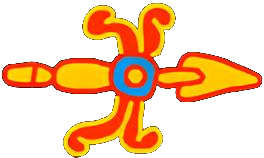
Besides, over the body of the image in relief, appears a symbol: a quinqunx surrounded by a round striped band, which, as will be explained later, represents also the moment previous to universal creation.
We have, then, that such moment is represented, essentially, by the union of two serpents and a human being, either his face, or some other of his parts. When it is his face, his union with the serpents is represented in the upper lip.